war story
Altenau, Germany - Jan 21, 2026
...With thoughts of those who are holding on
...With thoughts of those who are holding on

aiI was fifteen or sixteen — that age when everything inside sounds too sharp, and every word from an adult feels hostile. My father and I argued until his voice rose into a threatening shout, on the verge of turning into a fight. In that moment, our apartment once again stopped being a safe place for me. Staying meant admitting defeat, fear, dependence. Slamming the door loudly, as if to underline my protest, I simply left.
aiIt was winter. Not the pretty kind we post on social media, but an ordinary one — cold, with harsh air that cut into the lungs… probably around minus twenty-five degrees. I stepped outside almost automatically, not knowing where I was going. There was only one thing that mattered: not going back. My stubbornness held me tighter than any lock.
aiAt first, I warmed myself in apartment stairwells. I went in, stood between floors, listened to footsteps, to the sound of the elevator, to strangers’ voices behind closed doors. There was warmth on those staircases —warmth not meant for me. I knew I couldn’t stay long, and yet I remained until my body began to shiver from the cold creeping inside, until my fingers started to stiffen and go numb.
aiThen I found another way — the trolleybus. I rode it in a loop, and it was warm there. I warmed myself, watched through the window identical streets, streetlights, people who were most likely heading home, because it was already evening. The conductor, the other passengers — none of them knew that I wasn’t traveling anywhere, that I was hiding. It gave me a strange feeling: I was among people and, at the same time, completely alone.
aiIt got dark. The thought of going back came again and again, but each time I pushed it away: returning felt worse than the cold. That night, I understood for the first time that stubbornness can be a form of survival, even when it hurts.
aiI didn’t feel like a heroine. I felt alive, angry, frightened, and very — as it seemed then — grown-up. And this was not a “beautiful story of running away,” but the story of a teenager who didn’t know any other way to protect herself.
aiMany years passed.
That night, I understood for the first time that stubbornness can be a form of survival, even when it hurts.
aiThat winter was very cold again. I was coming home and, on my stairwell, between floors, I saw her. A woman was sitting crouched down, curled in on herself, as if trying to disappear.
aiShe wore a thin jacket, her reddened hands were motionless, her gaze fixed on the floor. I understood immediately that she had nowhere to go.
aiI stopped. In my head, an adult, cautious voice switched on instantly: it’s dangerous, you don’t know her, she’s homeless and could rob you. I had rational reasons to walk past.
aiCold that wasn’t only in the body. And that recognition turned out to be stronger than fear. I spoke to her and invited her into my apartment.
aiI turned on warm water — not hot, carefully — and we slowly warmed her hands, as if returning them to her body. She barely spoke. Then I gave her hot food — the simplest kind — but she held the plate as if it were something fragile and important. I could see how, together with the warmth, presence was gradually returning to her.
aiAt the end, I gave her some money so she could get to a warming center for the homeless. I explained how to get there. She thanked me and left. I closed the door, and only then did I feel how hard my heart was pounding: I suddenly understood clearly — in other people’s stairwells and on the trolleybus, I had remembered not only the cold. I had remembered how important it is when someone finally stops.
aiAnd perhaps all this time I had simply been living in order to one day become that “someone.”
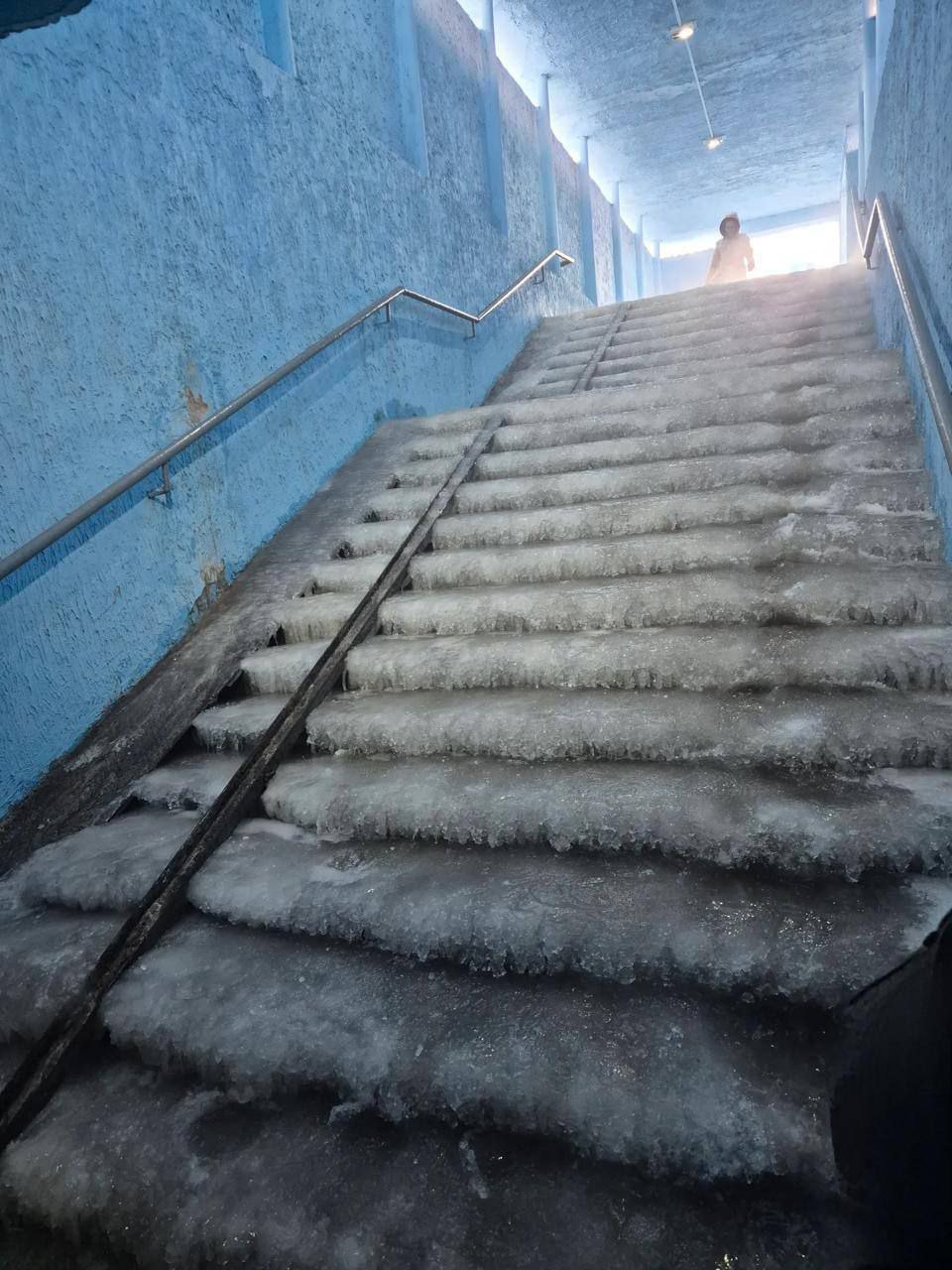
Stairway in a Kyiv metro passage during the blackout
The conditions in which Ukrainians restore energy and heating after Russian shelling. Author of the DTEK video
Stairway in a Kyiv metro passage during the blackout
